Publications
May 16, 2019
National Center for Health Statistics data for 2018 show the lowest general fertility rate on record and just 3,788,000 births—the fewest in 32 years. There were 528,000 fewer births (12 percent) in 2018 than in 2007, just before the Great Recession began to influence births.
May 13, 2019
The “Supporting Coös Youth on the Path to Adulthood” conference was held on October 26th, 2018, at the Mountain View Grand Resort and Spa in Whitefield, New Hampshire. This report describes the themes and priorities heard during the conference’s small and large group discussions.
May 13, 2019
The Coös Youth Study was a ten-year research project about growing up in a rural county undergoing transformative economic and demographic changes. The study addressed how these changes affected youths’ well-being as well as their plans to stay in the region, pursue opportunities elsewhere, permanently relocate, or return to their home communities with new skills and new ideas.
May 8, 2019
In October 2018, the last period for which we conducted public opinion research, support for a paid family and medical leave program was high. Seventy-eight percent of New Hampshire residents stated support for a program that would provide a portion of wages to workers taking leave for personal or family medical reasons.
May 1, 2019
Gender inequality has declined precipitously over the past half-century, fundamentally altering women’s, men’s, and their children’s lives. Despite these changes, women continue to pay a wage penalty for motherhood, earning about 5 percent less than equally-qualified childless women.
April 25, 2019
Although the role of government programs in alleviating poverty is widely studied, far less attention is paid to how these programs may differentially impact people with different racial-ethnic identities. Given that poverty rates among non-Hispanic whites are significantly lower than among other groups, programs with disparate effects by race can either widen or decrease racial-ethnic gaps in…
April 19, 2019
In this data snapshot, author Kenneth Johnson reports that the population of New Hampshire grew by 6,700 between July of 2017 and July of 2018 to 1,356,000 according to new Census Bureau estimates. This gain coupled with a population increase of 7,400 last year added 14,100 residents to the state between 2016 and 2018.
April 18, 2019
For the first six years of this decade, rural America experienced overall population loss for the first time in history. New Census Bureau estimates suggest that last year overall growth accelerated in nonmetropolitan America where 46.1 million people reside.
April 16, 2019
Federal programs are critical for helping those with low incomes make ends meet. But not all such programs are equally effective at reducing poverty, nor do they benefit all of those in poverty uniformly.
April 9, 2019
Legislators across the United States are discussing paid family and medical leave, which allows workers to take an extended number of weeks away from their jobs, with some wage replacement, to care for a seriously ill, injured, or disabled family member, or a new child, or to tend to one’s own serious health condition. California, New Jersey, Rhode Island, and New York currently have public…

March 27, 2019
The Opportunity Zones legislation was designed to mobilize new levels of capital into low- and moderate-income (LMI) communities – areas that have historically been overlooked and underserved by mainstream capital markets. As longstanding financial partners to LMI communities, Community Development Financial Institutions (CDFIs), it would seem, are positioned to play a pivotal role in the…
March 7, 2019
The U.S. population grew by just 0.62 percent last year, the smallest rate of increase in eighty years. Future growth now depends on minority population gains, because the white population is no longer growing.
February 21, 2019
When low-income residents struggle to make ends meet, non-profit social service agencies can help fill the gaps. In doing so, these agencies must find sufficient funding, retain qualified staff, and craft efficient service delivery mechanisms that are respectful of clients and communities. Some of the challenges that service providers encounter are exacerbated by rural characteristics, such as…
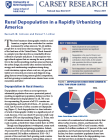
February 6, 2019
This brief examines demographic trends in rural America, a region often overlooked in a nation dominated by urban interests. Yet, 46 million people live in rural areas that encompass 72 percent of the land area of the United States. “Rural America” is a simple term that describes a remarkably diverse collection of people and places.
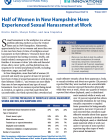
January 30, 2019
Sexual harassment in the workplace is a serious problem affecting workers across the United States and in New Hampshire. Nationwide, approximately four in ten women and more than one in ten men have been victims of workplace sexual harassment in their lifetimes.
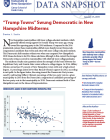
January 15, 2019
New Hampshire municipalities with fewer college-educated residents, which generally offered strong support for Donald Trump two years ago, swung toward the opposing party in the 2018 midterms.
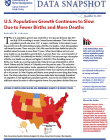
December 20, 2018
The U.S. population grew by just 2,020,000 or 0.62 percent between July 2017 and July 2018 according to recent Census Bureau estimates. This is the lowest population growth rate since 1937.
December 14, 2018
This study examines the on-going work of New Hampshire Listens, a convener of deliberative conversations, specific to their work with police-community relationships. Attending particularly to the facilitators and planners of New Hampshire "Blue and You" in a small city, the study found systemic practices of early stakeholder involvement in the planning, holding space for disparate views…
December 11, 2018
An ongoing concern in both urban and rural America is the tradeoff between residential and commercial development and the conservation of forestland, shrublands, and grasslands, commonly referred to as greenspace. As communities develop, adding schools, housing, infrastructure, and the commercial space needed for an expanding population and economy, greenspace remains critical because it…

December 6, 2018
New Hampshire received a significant net inflow of people from other U.S. states between 2013 and 2017 according to new Census Bureau estimates. The average annual domestic migration gain was 5,900 between 2013 and 2017
