download the brief
Key Findings

Enrollment in the New Hampshire Child Care Scholarship Program has more than doubled since program eligibility changed in 2024, with 5,817 children enrolled by December 2025.

Almost two-thirds of children actively using a New Hampshire child care scholarship are under age five.
Children in all counties utilize the New Hampshire Child Care Scholarship Program, reaching more than 7 percent of children under age 5 in Belknap, Carroll, and Sullivan Counties.
New Hampshire Child Care Scholarship Program Participation Continues to Grow
Changes to New Hampshire’s Child Care Scholarship Program implemented in January 2024 have more than doubled programmatic reach in just two years.1 In December 2023—the month before expanded eligibility took effect—2,660 children were enrolled in the program.2 By December 2025, enrollment has reached 5,817 children, more than doubling the program’s enrollment over the period. Participating children live in more than 3,900 unique families. Of the enrolled children, most (84.2 percent) are connected to a child care provider and are actively using their scholarship.
There are several reasons that the remaining 16 percent of children who are already enrolled might not be connected to a provider, primarily related to timing and supply-side constraints. For example, families may be searching for a provider who accepts scholarships or waiting for an open slot that meets their families’ needs. Families might also purposely wait to be deemed scholarship-eligible before seeking care, since any tuition owed between child care program enrollment and the family’s official scholarship eligibility determination would need to be paid by the family directly or absorbed by the child care provider. This challenge has been addressed by New Hampshire’s new policy effective January 1, 2026, which allows families to be “presumed eligible” before being formally approved.3 This ensures that child care programs are not at risk of having to waive costs for families in need and ensures adults are able to work and children are able to learn sooner.
Box 1. How does the New Hampshire Child Care Scholarship Program work?
Child care is a core element of the state’s workforce infrastructure for families with children, although prices can create uneven access for moderate- or lower-income families. The New Hampshire Child Care Scholarship Program (NH CCSP), a federal-state partnership administered by the New Hampshire Department of Health and Human Services, helps unlock access to high-quality child care for these families. The NH CCSP helps eligible families by offsetting tuition costs up to an established maximum rate. Families with incomes above the poverty line pay a small income-specific “cost share” fee,4 along with any co-payment (the difference between the maximum reimbursement rate and program tuition costs) that providers may charge.5 In essence, child care scholarships function like a “coupon” accepted by 80.2 percent of licensed child care programs statewide.
Box 2. How do federal policies influence the NH CCSP?
The New Hampshire Child Care Scholarship Program (NH CCSP) is primarily funded through the federal Child Care and Development Fund (CCDF). About 70 percent of CCDF funds go toward improving access for families directly, largely through child care scholarships;6 federal guidelines cap proportions that can be spent on other kinds of spending, like program administration.7
Although most of the funding is federally allocated, states have flexibility to design their program’s implementation within federal guidelines. Under a federally approved plan, states receive a set amount of CCDF funding. Lead agencies, including New Hampshire’s, then draw down those funds as needed, submitting quarterly reports to the federal government.8 On a long-term basis, states are impacted by changes to federal guidance that influence how the program can be designed and delivered. In the shorter term, states may be impacted by federal administrative changes that alter processes related to funding disbursements.9
Young Children Statewide Are Served by Scholarship Program
Figure 1 shows that most New Hampshire children who use the scholarship program are not yet of school age (65 percent). Nearly one-third of children currently using a child care scholarship are under age 3.
Children in each New Hampshire county utilize the CCSP. Aligned with the state’s population distribution, the largest number of enrolled children are in Hillsborough County, while the smallest number is in Coös County. However, as a share of all children under age 5, scholarship utilization is highest in Belknap, Carroll, and Cheshire Counties, where more than 7 percent of all children under age 5 utilized the program (see Figure 2).
Figure 1. Age of Children Enrolled in the NH Child Care Scholarship Program and Linked to a Child Care Provider, December 2025

Source: Carsey School of Public Policy analysis of NH Department of Health and Human Services data, December 2025
Program Complexity Means Room to Grow
The NH CCSP is a core support for the state’s working families. According to recent research from the New Hampshire Fiscal Policy Institute, each unavailable child care slot “may have cost the state’s economy as much as $35,000 in lost earnings to families and in forgone revenues to businesses as well as to the State and local governments.”10 By improving affordability of child care for 5,817 children, the program may act as an important economic engine for the state, potentially generating more than $200 million in economic returns for the state. The program’s reach has nearly doubled since its eligibility guidelines were expanded in January 2024. At a time when families struggle with child care affordability11 and the state continues to face risks of a labor force shortage,12 ensuring working families can access high quality learning opportunities for their children remains critical.
In some ways, child care scholarship utilization mirrors the distribution of populations most likely in need of social service supports more generally. For example, there is relatively low use of child care scholarships in Rockingham County, which also has generally higher incomes and low participation in programs like Medicaid.13 In places like Carroll County—where service-sector jobs predominate and wages tend to be lower—utilization is slightly higher.14 However, the NH CCSP is a complex program and family utilization is influenced by a myriad of factors, including eligibility around family income and work activities, family knowledge about the program, availability of a child care provider that matches family needs, local provider participation in the scholarship program, and more. Ensuring New Hampshire families can continue to leverage this federal-state program will require ongoing local partnerships that allow the program to remain responsive to the needs and barriers of families statewide. Continued monitoring of scholarship implementation will support the success of those efforts.
Figure 2. Percent of Children Under Age 5 Enrolled in the NH Child Care Scholarship Program and Linked to a Child Care Provider by County, December 2025
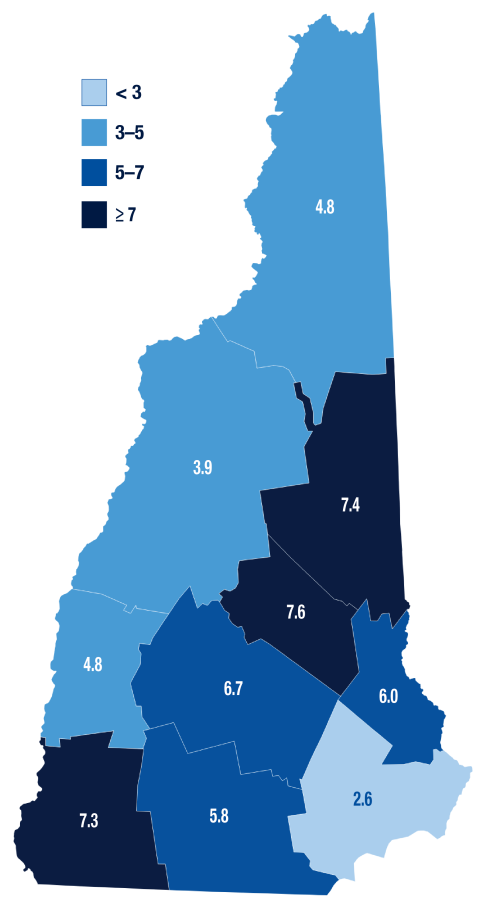
Source: Carsey School of Public Policy analysis of NH Department of Health and Human Services data, December 2025, and New Hampshire Vital Statistics. Note: County-level counts of children under age five are estimated as the number of children born to mothers residing in each county between 2021 and 2025. Three children are excluded from this map because they could not be associated with a New Hampshire county.
Endnotes
- Carsey School. 2025. Reach and Utility of the New Hampshire Child Care Scholarship Program. https://carsey.unh.edu/publication/reach-utility-new-hampshire-child-care-scholarship-program
- New Hampshire Department of Health and Human Services. 2024. Operating Statistics Dashboard. https://gc.nh.gov/lba/Budget/FiscalItems/2024-08-16_Agenda_Items/FIS_24-260.pdf#page=6
- New Hampshire Bulletin. 2025. State launching new programs to expand and improve Child Care Scholarship Program. https://newhampshirebulletin.com/2025/12/15/state-launching-new-programs-to-expand-and-improve-child-care-scholarship-program/
- New Hampshire Department of Health and Human Services. 2024. Cost Share and Provider Co-Pay (FAM). https://www.dhhs.nh.gov/fam_htm/html/938_cost_share_and_provider_co_pay_fam.htm
- New Hampshire Department of Health and Human Services. 2025. Child Care Scholarship Income Eligibility Levels. http://dhhs.nh.gov/sites/g/files/ehbemt476/files/documents2/form-2532-child-care-scholarship-income-eligibility-levels-jan-2024.pdf
- Administration for Children and Families. 2025. Table 3a – All Expenditures by State – Detailed Summary (FY 2022). https://acf.gov/occ/data/table-3a-all-expenditures-state-detailed-summary-fy-2022
- Administration for Children and Families. 2025. Child Care and Development Fund (CCDF) Fiscal Fundamentals. https://childcareta.acf.hhs.gov/sites/default/files/new-occ/resource/files/2025-ccdf-fiscal-fundamentals-for-states.pdf
- U.S. Department of Health and Human Services, Program Support Center. https://pms.psc.gov/grant-recipients/grant-recipient-faqs.html
- AP News. 2026. Trump administration calls for tightening child care funds after fraud accusations. https://apnews.com/article/minnesota-child-care-funds-fraud-trump-1d6edb8511d916fc3a5dc3b339d94e37
- New Hampshire Fiscal Policy Institute. 2025. The Economic Impact of the Granite State’s Child Care Shortage. https://nhfpi.org/resource/the-economic-impact-of-the-granite-states-child-care-shortage/
- Carsey School of Public Policy. 2024. High Child Care Costs Strain NH Family Budgets. https://carsey.unh.edu/publication/high-child-care-costs-strain-nh-family-budgets
- New Hampshire Employment Security. 2025. Economic Analysis Report. https://mm.nh.gov/files/uploads/nhes/documents/economic-analyisis-2025.pdf
- New Hampshire Fiscal Policy Institute and Carsey School of Public Policy. 2025. “Data Presentation and Discussion.” https://nhfpi.org/assets/2025/01/Carsey-NHFPI_NH-DHHS-SLT_Data-Presentation-1.16.25.pdf
- New Hampshire Employment Security. 2025. Industry Projections by County. https://www.nhes.nh.gov/document/industry-projections-county
About the Authors
- Harshita Sarup is a research scientist at the Center for Social Policy in Practice at the Carsey School of Public Policy.
- Jess Carson is the director of the Center for Social Policy in Practice and a research assistant professor at the Carsey School of Public Policy.
Acknowledgements
The authors are grateful to colleagues at the Department of Health and Human Services for their thought partnership and willingness to share data. Special thanks to the Bureau of Child Development and Head Start Collaboration’s Terri Peck and Briana Ermanni. Airole Warden and Rebecca Woitkowski also provided valuable feedback in the brief’s development. Layout and editorial assistance was provided by Laurel Lloyd at the Carsey School of Public Policy. This work was generously supported by the Couch Family Foundation.
© 2026 University of New Hampshire. All rights reserved.

