download the primer
Key Findings

Child care programs have complex budgets; tuition revenue is often insufficient for operations.

Labor is the costliest element of child care program operation, accounting for around 70 percent of program expenditures.

A lack of data limits planning for a high-quality early care and education system that is financially sustainable.
The Carsey School of Public Policy’s Granite Guide to Early Childhood series highlights issues in New Hampshire’s early care and education (NH ECE) sector by synthesizing evidence on a set of interconnected topics. This primer focuses on operating costs for New Hampshire child care programs. For more detail about the series, visit the NH ECE Research Consortium webpage.
Child Care Providers Are Economically Strained and Financially Complex
Despite the high price of child care for families and an undercompensated workforce, child care programs face slim profit margins and financial instability. Challenges like high operating costs and low compensation are common risks for program closures nationwide and likely play a role in the 11 percent net loss in New Hampshire licensed child care programs between 2017 and 2025.1
Comprehensive revenue and expense data for child care programs are rare, both nationally and for New Hampshire. However, one important recent exception is a new cost model that estimates the true cost of care for different program types in each state. In New Hampshire, for instance, operating a program with a separate classroom for infants, toddlers, three-year-olds, and four-year-olds would cost between $1.1 million per year (if paying educators at current levels and offering no benefits) and $1.8 million (if paying educators a living wage with benefits).2 These costs would result in infant tuition between $21,000 and $33,000 per year, yet center-based tuition for infants averaged $16,000 in 2024. The disparity between prices that the market can bear and the costs of operating a program—particularly a high-quality program with appropriate staff compensation—helps explain why programs are financially unstable.
Providers Face Limited Non-Tuition Revenue Streams
Amid limited public funding, national data show family-paid tuition dominates program revenue. Non-tuition revenue opportunities are piecemeal: the Child Care and Development Fund (CCDF), the main federal investment mechanism, is limited in amount and allowable uses, as are federal funds for Head Start and the Child and Adult Care Food Program (CACFP). COVID-era relief funds provided temporary support, but expired by fall 2024, and thus far, NH state funds to support the workforce were available only for 2025. Beyond these fluctuating funds, programs may turn to grants, fundraising, and other smaller revenue streams to fill gaps.
Program Budgets Give Insight to Financial Models
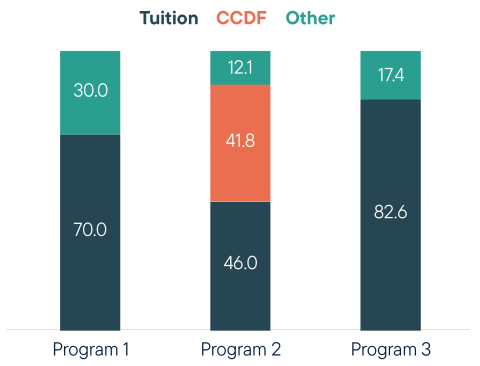
To contextualize cost-model estimates, we analyze operating budgets from three NH ECE programs, shared by partners for this primer. While these examples demonstrate how programs can sustain operations amid funding constraints, each operates with limited flexibility and significant tradeoffs. Figure 1 summarizes program revenue, highlighting the dominance of tuition, and the relevance of CCDF for Program 2, in a lower-income community.3
Personnel Expenses Lead Expenditures
For all three programs, staff wages and benefits are the largest expense category, accounting for more than 70 percent of expenditures (Figure 2).4
Figure 1. Revenue Sources Among Three Active NH ECE Programs
Source: Carsey School analysis of 2024/2025 budgets
Figure 2. Expense Categories Among Three Active NH ECE Programs

Source: Carsey School analysis of 2024/2025 budgets
Despite similarly high staff expenses, program expenses do vary. For instance, under facilities, Program 1 had rental costs, while Program 3 owned its site, but required costly maintenance. Meanwhile, under “other,” food costs were the most common expense and varied from 0 to 5 percent of expenditures across programs.
In the end, Program 1 lost money, Program 2 broke even, and Program 3 had excess revenue. Yet each program likely faced difficult tradeoffs: for instance, Program 1 provided employee benefits, but spent the lowest share on supplies. Meanwhile, Program 3 had excess revenue, but offered employees a more limited healthcare package. In other words, meeting the standards of high-quality care, including professional development, competitive wages, and safe, efficient facilities may be incompatible for programs, but in different ways.
In Consideration of a System-Wide Look at Financial Sustainability
Using data from a nationally developed cost model and three NH ECE programs, this primer underscores challenges at the intersection of affordability, quality, and program sustainability. Family tuition is essential and insufficient as a revenue source. That programs charge less than the cost of operating is both critical for families and detrimental to the sector’s financial sustainability. Programs rely on supplemental revenue options, navigating unstable funding streams, evolving programmatic rules, and unexpected costs without a safety net.
To stabilize and sustain a diverse and high-quality ECE supply, NH programs cannot navigate the patchwork financial landscape alone. Attention to alternate funding streams through fiscal mapping, engaging stakeholders outside the traditional ECE system, and partnering with the private sector hold significant promise for the state as it develops a long-term plan for a sustainable statewide ECE system.
About the Authors
- Tyrus Parker is a research scientist at the Center for Social Policy in Practice at UNH’s Carsey School of Public Policy.
- Jess Carson is the director of the Center for Social Policy in Practice and a research assistant professor at UNH’s Carsey School of Public Policy.
Acknowledgments
This series was made possible through generous funding and partnership from the Couch Family Foundation. Special thanks to the three providers who graciously shared their budgets for this primer.
The Carsey School of Public Policy at the University of New Hampshire is nationally recognized for its research, policy education, and engagement. The school takes on the pressing issues of the twenty-first century, striving for innovative, responsive, and equitable solutions.
© 2026 University of New Hampshire. All rights reserved.

