Decarbonization from the Ground Up: Climate Advocacy and Utility Partnerships
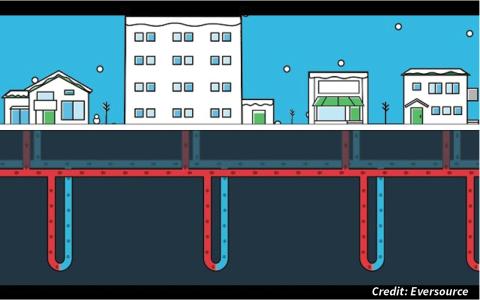
What happens when climate activists and gas utility leaders find common ground? In Massachusetts, the result has been the first-in-the-nation networked geothermal heating and cooling system – an innovative model for decarbonization that’s now being considered by utilities and communities across the country. Zeyneb Magavi, Executive Director of HEET, and Liam Needham, Director of Customer Thermal Solutions at Eversource Energy, shared how their unlikely coalition came together, what it took to earn trust and build the Framingham pilot project, how to engage customers and community leaders, and how this replicable model offers a path toward equitable clean energy transitions nationwide. This Carsey Policy Hour was offered jointly with the New England Municipal Sustainability (NEMS) Network and the UNH Sustainability Institute.
Watch the Video
View the Presentation Slides
- Presentation by Zeyneb Magavi, HEET: #Think Thermal, Together
- Presentation by Liam Needham, Eversource: Networked Geothermal Pilot
About the Speakers
Zeyneb Magavi is Executive Director of HEET (Home Energy Efficiency Team), where she designed and helped to launch the GasToGeo initiative to drive rapid, efficient, and equitable decarbonization of heating and cooling through deployment of ambient geothermal networks. Today GasToGeo demonstration projects are moving forward across the country, and Zeyneb has convened an independent research team to study these first transitions. Zeyneb studied physics, global health, and sustainability and has worked at BBN Technologies, Harvard, MIT, and multiple startups. She is committed to creating and driving forward compassionate, multi-disciplinary, and innovative solutions to the urgent challenge of climate change.
Liam Needham is the Director of Customer Thermal Solutions within Eversource’s gas business unit. He is responsible for marketing, customer connections, and major account management across Eversource’s gas business, which includes traditional and clean technology offerings. He plays a lead role in policy efforts regarding the future of natural gas and other strategic initiatives that help Eversource provide safe, reliable, cost-effective clean energy solutions to meet its customers’ needs. Liam’s team has successfully brought a first-in-the-nation Networked Geothermal Pilot to Framingham, Massachusetts, and is working on the next phase of making this technology an accessible option for customers.
Liam holds a Bachelor of Science degree in Business Administration, with a concentration in Marketing from Babson College. Before joining Eversource, Liam held various leadership roles at NiSource within the Sales and Marketing organization.
What makes a community a strong candidate for geothermal projects?
The reality is, there are very few exceptions to the rule that it works anywhere you have a cluster of buildings. The question is more about cost. If the drilling is really hard, if there aren't that many customers, it's too high cost. It's really a cost equation, and the first loop is always more expensive, and then the cost comes down. So, what you want to do is pick that first project to be as easy as posible on cost.
That's why there's so much effort around this site selection. It's to give this technology its best first chance to avoid the big problems.
The other component is if there is a larger user, such as a campus-type setting. We're seeing this in Massachusetts and across the country, where there's one entity to deal with rather than multiple.
What helps move a project from interest to reality?
We just ran something we call a kickstart over the past year and worked with a bunch of interested communities to do community-initiated projects. Liam spent a lot of time talking about the community outreach which was really fabulous in Framingham.
I think to me (Zeyneb), that's the critical piece at the beginning. Where else do you have the ability to have that kind of stakeholder network and collaboration? It takes a network of people to network buildings. As it scales, that won't matter as much. People will know about it, it will be a known thing for municipalities.
What can municipalities do to support geothermal development?
There's so much to do, one thing is simply education. People don't know what it is and they need to know.
I think the other thing I want to flag is the old building stock we have in New England is really challenging. It doesn't matter what technology you're deploying; it's challenging. We have a hundred years of delayed maintenance in a lot of buildings, and the minute you cross the threshold as a utility, you can't ignore that stuff.
The asbestos, the mold, the code violations, we all know it's there, and that is the most cost-uncertain and cost-driving element. So, one of the things we're exploring is to look at an aggregated street location building or building weatherization approach to bring people together to address these things.
The physical infrastructure in the street is doable. The challenge is building a retrofit process, and I think that is a universal challenge independent of technology.
What is the current outlook for policy and funding?
I think it is important to mention that our current administration is very pro geothermal and the only tax credit that still stands is the Geothermal Commercial Tax Credit in the House Bill. We don't know where that is going to land, but that is critical.
This is a path forward at every level, and I would say the other piece is that we are still in the learning mode. Yes, it works, but how do we bring down the cost curve?
I'm really excited about the initial data, so stay tuned. Our modeling tool and data show that the system in Framingham is vastly outperforming the model, and that is incredible news.

